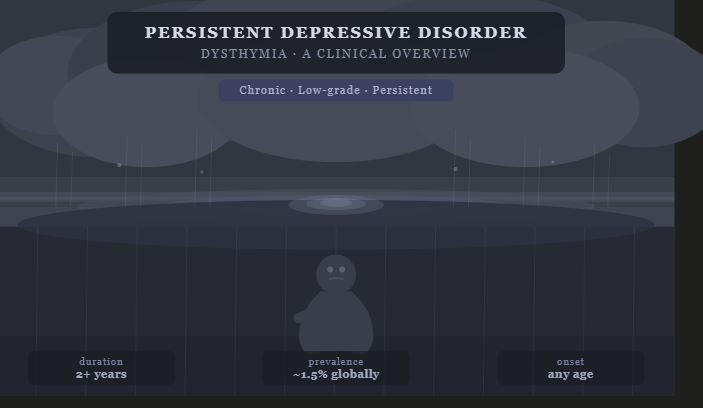
A Comprehensive Clinical Review
Persistent Depressive Disorder (PDD), formerly designated dysthymia or dysthymic disorder in DSM-IV, was introduced as a unified category in the DSM-5 (2013) to consolidate chronic major depressive disorder and dysthymia into a single diagnostic construct. It is characterized by a depressed mood that persists for most of the day, on more days than not, over a minimum of two years in adults and one year in children and adolescents. What distinguishes PDD from acute depressive episodes is its insidious onset and unrelenting chronicity that individuals rarely experience sustained euthymia, and the condition frequently begins so gradually that patients come to regard their persistent low mood as intrinsic to their personality rather than a treatable psychiatric disorder (Patel et al., 2024).
The clinical burden of PDD is substantial. Schramm et al. (2020), in their landmark narrative review published in The Lancet Psychiatry, established that PDD is often more functionally disabling than episodic major depressive disorder (MDD) precisely because of its persistence and the cognitive-interpersonal deficits it engenders over time. PDD can co-occur with MDD — a phenomenon termed “double depression” — and is associated with significantly elevated rates of psychiatric comorbidity, occupational impairment, and suicide risk. Recognition of PDD demands a high index of clinical suspicion, structured assessment, and a coordinated, interdisciplinary treatment approach. The blog is Grounded in DSM-5-TR Criteria, Nursing Process (ADPIE) and Evidence-Based Practice to illuminate on PDD,
Epidemiology of Persistent Depressive Disorder (PDD)
Distribution
Prevalence of Dysthymia
The DSM-5-TR estimates a 12-month prevalence of approximately 0.5% for pure dysthymia and 1.5% for chronic MDD, the two primary forms now subsumed under PDD. Data from a large Swiss cohort study of 3,720 participants found prevalence rates of 15.2% for PDD with persistent major depressive episodes, 3.3% for pure dysthymia, and 28.2% for MDD (Patel et al., 2024). Among children and adolescents, 12-month PDD prevalence is estimated at 1–3%, though it is frequently underrecognized in this population and masked by comorbid anxiety and externalizing disorders (Walter et al., 2023).
Globally, PDD remains substantially underdiagnosed. Schramm et al. (2020) emphasize that dysthymia is particularly difficult to detect in primary care and psychiatric settings because patients present during superimposed major depressive episodes, often without disclosing the chronic baseline depressive state. This diagnostic latency prolongs the period of untreated illness and worsens long-term outcomes.
Patterns — Sex, Age, Location, and Season
PDD is approximately twice as prevalent in women as in men, consistent with sex-related patterns across depressive disorders. This disparity reflects an interplay of neurobiological factors (e.g., hypothalamic-pituitary-adrenal axis sensitivity, sex hormone fluctuations), psychosocial stressors (gender-based violence, caregiver burden, socioeconomic disparities), and differences in help-seeking behavior. Onset typically occurs in childhood, adolescence, or early adulthood; early-onset PDD (before age 21) is more prevalent and is associated with greater severity, higher comorbidity burden, and poorer treatment response (Patel et al., 2024).
There are no definitive geographic patterns for PDD, although urbanization, social fragmentation, and limited access to mental health care are recognized determinants. Seasonal variation is less prominent in PDD compared to seasonal affective disorder; however, some patients report symptom intensification during winter months, consistent with the known effects of reduced light exposure and social withdrawal on mood regulation (APA, 2019).
Determinants
Etiology
The etiology of PDD is multifactorial, involving the intersection of biological, psychological, and social determinants:
Biological: Neurobiological evidence implicates dysregulation of monoamine neurotransmitter systems, particularly serotonin, dopamine, and norepinephrine. HPA axis hyperactivity with elevated cortisol has been documented, suggesting a chronic allostatic stress response. Neuroimaging studies have identified structural and functional changes in the prefrontal cortex, hippocampus, and amygdala regions critical to mood regulation, stress reactivity, and cognitive processing. Schramm et al. (2020) highlight that the neurobiological basis of PDD, including dysthymia, likely involves both monoamine variations and corticotropin-releasing hormone dysregulation within the hypothalamus.
Psychological: Maladaptive cognitive schemas characterized by pervasive negativity, learned helplessness, and early-onset interpersonal difficulties are central to the maintenance of PDD. Individuals with PDD typically develop preoperational-level social cognition — that is, an inability to perceive a functional connection between their own behavior and its interpersonal consequences — a phenomenon that underpins the development of the Cognitive Behavioral Analysis System of Psychotherapy (CBASP) as the disorder-specific treatment.
Social: Adverse childhood experiences — including neglect, physical and psychological abuse, parental loss, and domestic violence — are among the most robust predictors of adult PDD onset. Wolf et al. (2023) demonstrated that childhood maltreatment is significantly associated with suicidal behaviors in PDD, underscoring the long-term psychiatric sequelae of early adversity. Chronic psychosocial stressors, social isolation, poverty, and low social support sustain the disorder in adulthood.
Risk Factors
- First-degree family history of depressive or mood disorders
- Female sex and early onset (before age 21)
- History of childhood maltreatment, neglect, or adverse childhood experiences (ACEs)
- Chronic medical conditions (e.g., diabetes, cardiovascular disease, chronic pain syndromes)
- Comorbid anxiety disorders, personality disorders, or substance use disorders
- Limited social support networks and social isolation
- Chronic psychosocial stressors, including unemployment and financial insecurity
- Prior depressive episodes or subsyndromal depressive symptoms (Patel et al., 2024; Walter et al., 2023)
Effects on Population
Individuals
PDD exacts a profound individual toll. Functional impairment in PDD is pervasive and comparable to or greater than that observed in episodic MDD, particularly in domains of occupational performance, interpersonal relationships, and self-care (Schramm et al., 2020). Economic consequences include increased healthcare utilization, absenteeism, presenteeism, and reduced lifetime earnings. Individuals with PDD carry a heightened risk of suicidal ideation and behavior — Hsiao et al. (2022) demonstrated that comorbid sleep disorders in PDD are associated with a significantly elevated suicide risk — reinforcing the need for systematic risk assessment in all clinical encounters (Patel et al., 2024).
Family
The chronicity of PDD imposes a significant caregiving burden on family members. Persistent low mood, anhedonia, social withdrawal, and irritability associated with PDD disrupt family communication, reduce relational quality, and increase the risk of secondary depression in caregivers. Children of parents with PDD are at elevated risk of developing depressive and anxiety disorders themselves, reflecting both genetic predisposition and the adverse psychosocial environment created by a chronically depressed parent (Walter et al., 2023). Families of adolescents with PDD may misinterpret persistent irritability or disengagement as behavioral problems rather than symptoms of a depressive disorder, further delaying diagnosis.
Community
At the community and societal level, PDD contributes substantially to the global burden of disease. The COVID-19 pandemic further amplified this burden; the Global Burden of Disease COVID-19 Mental Disorders Collaborators estimated that depressive and anxiety disorders increased markedly worldwide in 2020, with chronic depressive presentations disproportionately affecting communities with pre-existing mental health resource constraints (cited in Patel et al., 2024). Stigma around chronic depression discourages help-seeking, perpetuating untreated illness in the community. Workforce disability and reduced economic productivity associated with PDD impose costs that extend well beyond the healthcare system.
Assessment of Dsythymia
The assessment of PDD demands a thorough biopsychosocial approach guided by the nursing process. Critically, clinicians must adopt a longitudinal perspective — recognizing that PDD’s defining feature is chronicity, not episodic severity. The assessment phase draws on validated instruments alongside clinical judgment to establish symptom severity, functional impact, and suicidal risk.
Symptom Severity Assessment Tools
Preclinical: Patient Health Questionnaire-9 (PHQ-9)
The PHQ-9 is the most widely used and validated self-report depression screening tool in primary care and community settings globally. It operationalizes the nine DSM depressive symptom criteria into a brief, patient-completed measure scored on a 0–27 scale. Negeri et al. (2021), in a landmark individual participant data meta-analysis of 100 studies and 44,503 participants published in the BMJ, confirmed that the PHQ-9 at a cut-off of ≥10 achieves pooled sensitivity of 0.85 and specificity of 0.85 using semistructured diagnostic interview reference standards, supporting its utility as the first-line screener. The recommended scoring thresholds are:
- 1–4: Minimal depression
- 5–9: Mild depression — watchful waiting and lifestyle counseling
- 10–14: Moderate depression — treatment initiation recommended
- 15–19: Moderately severe depression — pharmacotherapy and/or psychotherapy
- 20–27: Severe depression — urgent clinical review, consider referral
In the context of PDD, the PHQ-9 may initially yield moderate rather than severe scores, reflecting the sub-acute severity that characterizes the disorder. Serial administration — ideally every 4 to 8 weeks — is essential to establish chronicity and track treatment response over time. Costantini et al. (2021) recommend a two-stage screening approach: PHQ-9 as the first-stage screen, followed by a structured clinical interview for positive screens. The PHQ-Adolescent (PHQ-A) version is validated for use in adolescent populations (Walter et al., 2023).
Clinical: Mental Status Examination (MSE)
The MSE provides a structured, systematic evaluation of the patient’s mental functioning at the time of assessment and is an indispensable component of initial and follow-up clinical evaluations in PDD. Key MSE domains and their PDD-specific presentations include:
Appearance: May appear fatigued, poorly groomed, or demonstrate psychomotor slowing; reduced spontaneous movement.
Behavior: Psychomotor retardation may be present; eye contact may be reduced; overall engagement often low.
Speech: Typically decreased in rate, volume, and spontaneity; reflecting underlying cognitive and motivational deficits.
Mood: Subjectively described as “low,” “empty,” “hopeless,” or “numb.” Critically, patients often report that this state is simply how they have “always felt,” reflecting the ego-syntonic nature of chronic depression.
Affect: Constricted or dysphoric; reactive affect is usually preserved, distinguishing PDD from more severe psychotic or melancholic presentations.
Thought Process: Organized, though often ruminative; patients may perseverate on themes of failure, unworthiness, or hopelessness.
Thought Content: Passive suicidal ideation is common. Active suicidal ideation requires immediate Columbia Suicide Severity Rating Scale (C-SSRS) administration and safety planning. Patel et al. (2024) note that PDD carries a heightened risk of suicidal thoughts and behaviors that may be as severe as — or greater than — those observed in MDD.
Cognition: Mild to moderate deficits in attention, concentration, memory, and executive function are frequently observed and contribute substantially to occupational and academic impairment.
Insight and Judgment: Partially preserved; limited insight into the treatable nature of their condition is common due to the chronic, ego-syntonic course.
Post-Clinical: PHQ-9 (Repeat Administration)
Regular PHQ-9 re-administration is central to monitoring treatment progress in PDD. Clinical guidelines recommend reassessment every 4–8 weeks during the treatment phase. A reduction of 5 or more points on the PHQ-9 is considered clinically meaningful; a score of ≤4 with sustained remission criteria is the treatment target. Persistent elevated scores despite adequate pharmacotherapy and psychotherapy should prompt diagnostic reassessment, medication optimization, or intensification of psychosocial interventions. Costantini et al. (2021) note that longitudinal PHQ-9 tracking provides objective documentation of treatment trajectory and supports evidence-based dose adjustments. The PHQ-9 is also used to evaluate for emergent symptom worsening — including suicidal ideation (Item 9) — at each follow-up encounter.
Diagnosis of Persistent Depressive Disorder (PDD)
Diagnosis of PDD is established through careful clinical interview aligned with the DSM-5-TR criteria. Given the disorder’s chronic, often ego-syntonic presentation, diagnosis requires deliberate probing into the longitudinal course of mood symptoms rather than relying solely on cross-sectional symptom assessment. Comorbid conditions and organic causes must be systematically excluded.
DSM-5-TR Diagnostic Criteria for Persistent Depressive Disorder (300.4)
Criterion A
Depressed mood for most of the day, for more days than not, as indicated by either subjective account or observation by others, for at least 2 years. In children and adolescents, mood can be irritable, and duration must be at least 1 year.
Criterion B
Presence of two or more of the following while depressed:
- Poor appetite or overeating
- Insomnia or hypersomnia
- Low energy or fatigue
- Low self-esteem
- Poor concentration or difficulty making decisions
- Feelings of hopelessness
Criterion C
During the 2-year period (1 year for children or adolescents), the individual has never been without the symptoms in Criteria A and B for more than 2 consecutive months at a time.
Criterion D
Criteria for a major depressive disorder (MDD) may be continuously present for 2 years. When a major depressive episode is present within PDD, both diagnoses are recorded and the specifier “with persistent major depressive episode” is applied to the PDD diagnosis.
Criterion E
There has never been a manic or hypomanic episode, and criteria have never been met for cyclothymic disorder.
Criterion F
The disturbance is not better explained by a persistent schizoaffective disorder, schizophrenia, delusional disorder, or other psychotic disorder.
Criterion G
The symptoms are not attributable to the physiological effects of a substance (e.g., a drug of abuse, a medication) or another medical condition (e.g., hypothyroidism).
Criterion H
The symptoms cause clinically significant distress or impairment in social, occupational, or other important areas of functioning (Patel et al., 2024).
Differential Diagnosis
Because PDD shares symptomatology with several mood, medical, and adjustment-related conditions, a structured differential is essential. Schramm et al. (2020) identify differential diagnosis as one of the most clinically challenging aspects of managing PDD, given its overlap with personality pathology, MDD, and subclinical anxiety.
Major Depressive Disorder (MDD)
MDD presents with discrete episodes of full-criterion depressive symptoms separated by periods of euthymia. In PDD, the baseline depressed mood persists even between any superimposed MDD episodes — the defining distinguishing feature. When MDD episodes occur within PDD, “double depression” is diagnosed. Chronicity — not acute symptom severity — is the key differentiating dimension (Patel et al., 2024). The trajectory of symptoms across years, rather than weeks, must be assessed. Clinicians should ask: “When was the last time you felt genuinely well for two or more months?”
Bipolar I and BD-II Disorders
The historical presence of a manic, hypomanic, or mixed episode is the critical exclusion criterion that separates bipolar disorders from PDD. Schramm et al. (2020) caution that PDD patients are sometimes misdiagnosed with bipolar disorder when irritability or brief reactive elation is mistaken for hypomania, and vice versa. A careful family psychiatric history, longitudinal review of mood episodes, and screening for hypomanic symptoms (e.g., with the HCL-32 or MDQ) are essential. Misclassification carries significant treatment implications, as antidepressant monotherapy may precipitate hypomania in bipolar II disorder.
Cyclothymic Disorder
Cyclothymic disorder involves alternating periods of subsyndromal hypomanic and depressive symptoms lasting at least 2 years. The distinction from PDD lies in the presence of subsyndromal hypomanic periods, which are absent in PDD. Both diagnoses share a chronic course, and differentiation requires careful longitudinal symptom mapping.
Medical and Organic Causes
Numerous medical conditions can produce chronic depressive symptoms that mimic PDD, including hypothyroidism, anemia, diabetes mellitus, chronic fatigue syndrome, obstructive sleep apnea, and neurological disorders (e.g., Parkinson’s disease, multiple sclerosis, early dementia). A comprehensive physical examination and laboratory workup — including thyroid function tests (TSH, free T4), CBC, metabolic panel, B12, folate, and fasting glucose — is mandatory prior to confirming a psychiatric diagnosis. Hsiao et al. (2022) specifically identified sleep disorders as a critical medical comorbidity in PDD that must be assessed and managed as part of the overall treatment plan, given their association with elevated suicidal risk.
Adjustment Disorder with Depressed Mood
Adjustment disorder arises in direct response to an identifiable stressor, with depressive symptoms emerging within three months and resolving within six months of the stressor’s termination. In PDD, the depressed mood is persistent (minimum 2 years), and its course is independent of discrete stressor exposure. The temporality and stressor-independence of PDD symptoms are the key differentiating features.
Treatment Plan for Dsythymia
Treatment Goals
Planning of PDD treatment must account for the disorder’s chronic trajectory, its high comorbidity burden, and the multi-level functional impairments it produces. Treatment goals should be developed collaboratively with the patient and, where appropriate, family members. Overarching goals include:
- Achieve full symptomatic remission — defined as PHQ-9 score ≤4 and sustained absence of criterion symptoms — not merely partial response
- Restore functional capacity across occupational, social, academic, and family domains
- Prevent recurrence through evidence-based maintenance pharmacotherapy and psychotherapy
- Identify and treat comorbid psychiatric and medical conditions (anxiety, substance use, sleep disorders, chronic pain)
- Reduce suicidal risk through ongoing assessment and safety planning
- Build the patient’s social support network and self-management competencies
- Engage the patient as an active collaborator in treatment decision-making (APA, 2019; Walter et al., 2023)
Implementation of Persistence Depressive Disorder Treatment Plan
Psychopharmacology
Pharmacotherapy is a cornerstone of PDD management, supported by evidence from systematic reviews and randomized controlled trials. Medication selection requires individualized assessment of symptom profile, prior treatment history, comorbidities, tolerability, and patient preference. Given the chronic course, adherence and long-term maintenance are as critical as initial response.
First-Line Pharmacotherapy
Selective Serotonin Reuptake Inhibitors (SSRIs) are recommended as first-line agents by the APA (2019) and the pediatric clinical practice guideline (Walter et al., 2023). They demonstrate comparable efficacy to psychotherapy, and their combination produces superior outcomes to either modality alone:
- Sertraline (50–200 mg/day) — extensive evidence base across age groups; preferred in adolescents and older adults due to favorable tolerability profile
- Escitalopram (10–20 mg/day) — well-tolerated, minimal drug interactions; preferred in elderly patients
- Fluoxetine (20–60 mg/day) — FDA-approved for pediatric depression; long half-life reduces discontinuation syndrome risk
Serotonin-Norepinephrine Reuptake Inhibitors (SNRIs), including venlafaxine (75–225 mg/day) and duloxetine (30–120 mg/day), are also considered first-line, particularly when comorbid chronic pain, fatigue, or anxiety disorders are present. Patel et al. (2024) note that multiple agents — including sertraline, fluoxetine, paroxetine, and moclobemide — have demonstrated superiority over placebo for PDD. A minimum 6–8 weeks at therapeutic dose is required to assess response, with the recognition that full remission in PDD may require 3–6 months of pharmacotherapy.
Second-Line Pharmacotherapy
Failure to achieve remission after two adequate SSRI trials warrants escalation:
- Augmentation with atypical antipsychotics (e.g., aripiprazole 2–15 mg/day, quetiapine 50–300 mg/day) is evidence-based for treatment-resistant depression and recommended in the APA guidelines (APA, 2019)
- Bupropion (150–450 mg/day): norepinephrine-dopamine reuptake inhibitor; preferred when prominent fatigue, hypersomnia, or SSRI-induced sexual dysfunction is present
- Mirtazapine (15–45 mg/day): noradrenergic and specific serotonergic antidepressant; useful when insomnia and appetite loss are prominent; weight gain is a common side effect
- Switching between agents within or across classes (SSRI to SNRI, or SNRI to bupropion) based on side effect profile and residual symptom pattern (Walter et al., 2023)
Third-Line Pharmacotherapy
Third-line options are reserved for treatment-resistant PDD and should be initiated in consultation with a psychiatrist. Patel et al. (2024) identify the following as emerging or specialist-level options:
- Tricyclic antidepressants (TCAs; e.g., nortriptyline, imipramine) — effective but limited by anticholinergic burden, cardiac risk, and narrow therapeutic window; require ECG monitoring in older adults
- Monoamine oxidase inhibitors (MAOIs; e.g., phenelzine) — reserved for refractory cases; require strict dietary tyramine restriction and careful polypharmacy review
- Lithium or thyroid hormone (T3) augmentation — evidence-based strategies for refractory chronic depression; lithium levels require regular monitoring
- Acetyl-L-carnitine — dietary supplement demonstrating antidepressant effects in dysthymia in clinical trials; cited by Patel et al. (2024) as an emerging adjunct for pure dysthymia
- Lamotrigine — a case report by Matsuzaka et al. (2022) documented sustained improvement with lamotrigine in PDD; may be considered in treatment-resistant cases, particularly where bipolar spectrum features are suspected
Maintenance pharmacotherapy for a minimum of 2 years is recommended following remission, with consideration of indefinite maintenance in patients with recurrent or treatment-resistant presentations (APA, 2019).
Psychotherapy
Psychotherapy is integral to the treatment of PDD and is recommended in combination with pharmacotherapy to maximize outcomes. Given the interpersonal and cognitive deficits that develop over the prolonged course of PDD, disorder-specific psychotherapies outperform generic supportive approaches.
Individual Therapy
Cognitive Behavioral Analysis System of Psychotherapy (CBASP): CBASP is the only psychotherapy developed specifically for chronic depression and PDD, and is classified as having strong evidence by the APA (2019). It addresses the preoperational cognitive-interpersonal patterns characteristic of PDD using three core techniques: Situational Analysis (which helps patients identify the connection between their behavior and interpersonal consequences), the Interpersonal Discrimination Exercise (which targets maladaptive expectations derived from formative relationships), and Behavioral Skill Training and Rehearsal. Schramm et al. (2020) conclude that CBASP demonstrates comparable efficacy to pharmacotherapy as monotherapy and produces superior outcomes when combined with antidepressants.
Cognitive Behavioral Therapy (CBT): CBT is the most extensively researched psychotherapy for depression across presentations and remains strongly recommended by the APA (2019). It targets negative automatic thoughts, cognitive distortions, and behavioral avoidance. In PDD, CBT is adapted to address the chronicity of negative schema development and to build behavioral activation over a longer treatment timeline (typically 16–24 sessions). Walter et al. (2023) identify CBT as a first-line psychotherapy for pediatric persistent depressive disorder, with strong evidence from randomized controlled trials.
Interpersonal Therapy (IPT): IPT focuses on the interpersonal contexts — grief, role transitions, role disputes, and interpersonal deficits — that precipitate and maintain depression. In PDD, IPT is particularly indicated for patients with prominent social isolation and relational difficulties. The APA (2019) includes IPT among the evidence-based psychotherapies recommended across the lifespan for depressive disorders.
Behavioral Activation (BA): BA directly addresses the withdrawal-avoidance cycle that sustains depressive symptoms by systematically increasing engagement in rewarding activities. BA has demonstrated standalone efficacy in depression and is a core component of CBT. Its structured, skill-building approach is well-tolerated by patients with significant motivation deficits characteristic of PDD.
Group Therapy
Psychoeducation Groups: Structured psychoeducation groups provide patients and families with accurate information about PDD — its neurobiology, treatment rationale, and self-management strategies — reducing stigma and improving treatment adherence.
Group CBASP and CBT: Group adaptations of disorder-specific therapies allow patients to practice interpersonal skills in a therapeutic social context, receive peer support, and benefit from shared learning. Group CBASP has demonstrated feasibility and efficacy in naturalistic clinical settings (Schramm et al., 2020).
Mindfulness-Based Cognitive Therapy (MBCT): MBCT integrates mindfulness meditation with cognitive therapy skills and is particularly well-supported for relapse prevention in recurrent and chronic depression. The APA (2019) identifies MBCT as an evidence-based intervention for depressive disorders; its emphasis on decentering from ruminative thought patterns makes it especially applicable to the chronic rumination characteristic of PDD.
Peer Support Groups: Peer-facilitated support groups address the social isolation that is both a risk factor and a perpetuating feature of PDD. They complement formal therapies and provide accessible, ongoing support across the community.
Complementary Care
Nursing
Nurses are at the frontline of PDD identification, monitoring, and therapeutic relationship-building. Key nursing responsibilities in PDD management include:
- Administering and interpreting the PHQ-9 at initial assessment and each follow-up; escalating scores or emergent suicidal ideation to the treatment team
- Conducting systematic suicidal risk assessment using validated tools such as the Columbia Suicide Severity Rating Scale (C-SSRS) at each clinical encounter
- Providing individualized psychoeducation about PDD, including the neurobiological basis of the disorder, anticipated treatment timelines, and medication expectations
- Monitoring medication adherence, side effects, and therapeutic response; coordinating with prescribers when adjustments are needed
- Utilizing motivational interviewing techniques to support patient engagement in treatment plans and reduce ambivalence
- Facilitating care coordination across the multidisciplinary team and connecting patients with community mental health and social support resources (APA, 2019)
Nutrition
The relationship between diet and mental health is increasingly supported by robust evidence. Key nutritional considerations for PDD include:
- Mediterranean dietary patterns — characterized by high intakes of vegetables, fruits, legumes, whole grains, fish, and olive oil — are associated with reduced depression risk and improved mood outcomes in clinical trials
- Omega-3 fatty acid supplementation (EPA and DHA from fish oil) demonstrates modest antidepressant effects and is a reasonable adjunct to pharmacotherapy, supported by the APA (2019)
- Folate and B-vitamin (B6, B12) adequacy supports monoamine synthesis; deficiency states are associated with antidepressant non-response and should be assessed in treatment-resistant cases
- Reducing ultra-processed foods, added sugars, and alcohol — which are associated with neuroinflammation and disrupted gut-brain signaling — is a pragmatic dietary intervention
- Regular meal timing and adequate hydration support medication tolerability, energy regulation, and mood stability
Physiotherapy
Exercise is among the most evidence-supported lifestyle interventions for depression. Noetel et al. (2024), in a systematic review and network meta-analysis of 218 randomized trials published in the BMJ, demonstrated that walking, jogging, yoga, strength training, and mixed exercise modalities all produced clinically meaningful reductions in depressive symptoms, with effect sizes comparable to pharmacotherapy and psychotherapy. For PDD specifically:
- Aerobic exercise — 30 minutes of moderate-intensity activity on 3–5 days per week — has antidepressant effects supported across multiple meta-analyses and represents a first-line lifestyle intervention
- Resistance training demonstrates independent benefits for mood, self-efficacy, energy, and cognitive function
- Physiotherapists design graduated, individualized exercise programs for deconditioned patients with PDD, particularly those with comorbid chronic pain or medical illness that limits spontaneous activity
- Mind-body interventions — including yoga, tai chi, and mindfulness-based movement — combine physical activity with attentional training, with growing evidence of efficacy in chronic depressive presentations (Noetel et al., 2024)
Social Work
Social workers address the social determinants of health that both contribute to PDD and hinder recovery:
- Conducting comprehensive psychosocial assessments identifying housing instability, food insecurity, financial hardship, domestic violence, and social isolation — key social risk factors for PDD
- Connecting patients to community mental health services, financial assistance programs, employment support, housing resources, and food security interventions
- Providing individual and family counseling to address interpersonal difficulties and caregiver burden, which are central features of PDD’s community impact (Walter et al., 2023)
- Advocating for patients within healthcare, legal, and social service systems, particularly for marginalized or underserved populations
- Facilitating safety planning and crisis management for patients identified as being at elevated suicide risk
Occupational Therapy
Occupational therapists (OTs) focus on restoring meaningful daily functioning — a critical target given the profound occupational impairment characteristic of PDD:
- Assessing functional performance in activities of daily living (ADLs), work, leisure, and social participation using validated tools (e.g., Assessment of Motor and Process Skills)
- Developing structured daily routines to counteract the anhedonia, amotivation, and executive dysfunction of PDD
- Implementing compensatory cognitive strategies (e.g., external memory aids, task segmentation) for patients with significant concentration and processing speed deficits
- Facilitating return-to-work programs and workplace accommodations, liaising with employers and occupational health services
- Using occupation-based activity as therapeutic media to build a sense of purpose, self-efficacy, and social connection — which are deficient in the preoperational interpersonal functioning characteristic of PDD (APA, 2019)
Evaluation of Dsythymia
Prognosis
The prognosis of PDD without treatment is poor. Approximately 10–20% of patients experience spontaneous annual remission; however, the majority follow a protracted course lasting years to decades if untreated. Early onset, high comorbidity burden (particularly anxiety disorders, personality pathology, and substance use disorders), history of childhood maltreatment, and inadequate social support are consistently associated with worse prognosis (Schramm et al., 2020).
With comprehensive treatment integrating pharmacotherapy and evidence-based psychotherapy, remission rates improve markedly, with 40–60% of patients achieving remission. However, relapse risk is high up to 70% within 3 years of treatment discontinuation — underscoring the importance of long-term maintenance strategies. Patel et al. (2024) emphasize that individuals with PDD face a heightened risk of suicidal thoughts and behaviors, with functional impairments that may be as severe as or exceed those of MDD; prognosis must therefore be linked directly to ongoing suicide risk monitoring.
Follow-Up Care
Structured, protocol-driven follow-up is essential in PDD given its relapse risk and the need for sustained treatment monitoring:
- Acute treatment phase (months 1–6): Monthly clinical review including PHQ-9 administration, MSE, medication review, and assessment of psychotherapy engagement
- Stabilization phase (months 7–24): Follow-up every 2–3 months; continue PHQ-9 monitoring; review maintenance pharmacotherapy plan
- Maintenance phase (beyond 24 months): Every 3–6 months; monitor for early relapse warning signs; reinforce lifestyle strategies and self-management skills
- Laboratory monitoring as clinically indicated: Thyroid function (TSH), metabolic panel, CBC, and medication-specific monitoring (e.g., lithium levels, QTc interval for TCAs, renal and thyroid function for long-term lithium use)
- Interdisciplinary case review at regular intervals, ensuring all team members are aligned on treatment goals and patient progress (Walter et al., 2023)
Referral
Specialist referral is indicated in the following circumstances:
- Non-response to two adequate antidepressant trials (treatment-resistant PDD) — refer to psychiatry for advanced pharmacological management, including augmentation strategies or consideration of neuromodulation
- Diagnostic uncertainty — particularly when bipolar spectrum disorder, psychotic features, or significant personality pathology is suspected
- Comorbid substance use disorders requiring dual-diagnosis specialist treatment
- Active suicidal ideation with plan, intent, or means; serious self-harm behavior
- Complex psychosocial situations requiring intensive case management or crisis intervention
- Pediatric and adolescent presentations — specialist child and adolescent psychiatry evaluation is recommended for all youth with PDD, as per Walter et al. (2023)
- Consideration of advanced therapies: electroconvulsive therapy (ECT), transcranial magnetic stimulation (TMS), or ketamine/esketamine (Spravato) infusions in refractory cases (APA, 2019)
Red Flags
The following presentations require immediate clinical action and should not be deferred to routine follow-up:
- Active suicidal ideation with plan, intent, or access to means; requires immediate safety assessment (C-SSRS), safety planning, removal of lethal means, and consideration of emergency psychiatric evaluation or hospitalization
- Recent suicide attempt or serious self-harm behavior
- Psychotic features emerging in the context of depression; may indicate psychotic depression or a manic/mixed episode; requires urgent psychiatric review and diagnostic reassessment
- Severe functional deterioration; inability to maintain self-care, hygiene, nutrition, or care for dependent children or vulnerable adults
- Emergence of manic or hypomanic symptoms during antidepressant therapy; mandates immediate review of the diagnosis and treatment regimen
- Clinical signs of serotonin syndrome (hyperthermia, neuromuscular rigidity, myoclonus, autonomic instability); a medical emergency requiring immediate intervention
- Disclosure of domestic violence, child abuse, elder abuse, or other safeguarding concerns; mandated reporting obligations apply (Patel et al., 2024; Wolf et al., 2023)
Resources
- National Alliance on Mental Illness (NAMI): the NAMI Helpline (1-800-950-NAMI)
- Mental Health America (MHA): free PHQ-9 screening, community resources, and peer support
- 988 Suicide and Crisis Lifeline: Call or text 988 — 24/7 crisis support for individuals in mental health emergencies
- Crisis Text Line: Text HOME to 741741 — 24/7 text-based crisis counseling
- American Psychological Association — Depression Resources
- Persistent Depressive Disorder
- International CBASP Society — CBASP training and resources for clinicians: www.cbaspsociety.org
References
- American Psychological Association. (2019, February). Clinical practice guideline for the treatment of depression across three age cohorts. https://www.apa.org/depression-guideline/guideline.pdf
- Costantini, L., Pasquarella, C., Odone, A., Colucci, M. E., Costanza, A., Serafini, G., Aguglia, A., Belvederi Murri, M., Brakoulias, V., Amore, M., Ghaemi, S. N., & Amerio, A. (2021). Screening for depression in primary care with Patient Health Questionnaire-9 (PHQ-9): A systematic review. Journal of Affective Disorders, 279, 473–483. https://doi.org/10.1016/j.jad.2020.09.131
- Hsiao, S.-H., Cheng, C.-C., Lin, I.-J., Yu, C.-P., Huang, Y.-C., Huang, S.-H., Sun, C.-A., Fann, L.-Y., Sheu, M.-Y., & Chien, W.-C. (2022). Persistent depressive disorder-related effect of sleep disorder on the highest risk of suicide in Taiwan, 2000–2015. International Journal of Environmental Research and Public Health, 19(20), 13228. https://doi.org/10.3390/ijerph192013228
- Matsuzaka, Y., Urashima, K., Sakai, S., Morimoto, Y., Kanegae, S., Kinoshita, H., Imamura, A., & Ozawa, H. (2022). The effectiveness of lamotrigine for persistent depressive disorder: A case report. Neuropsychopharmacology Reports, 42(1), 120–123. https://doi.org/10.1002/npr2.12222
- Negeri, Z. F., Levis, B., Sun, Y., He, C., Krishnan, A., Wu, Y., Bhandari, P. M., Neupane, D., Brehaut, E., Benedetti, A., Thombs, B. D., & the Depression Screening Data (DEPRESSD) PHQ Group. (2021). Accuracy of the Patient Health Questionnaire-9 for screening to detect major depression: Updated systematic review and individual participant data meta-analysis. BMJ, 375, n2183. https://doi.org/10.1136/bmj.n2183
- Noetel, M., Sanders, T., Gallardo-Gómez, D., Taylor, P., Del Pozo Cruz, B., van den Hoek, D., Smith, J. J., Mahoney, J., Spathis, J., Moresi, M., Pagano, R., Pagano, L., Vasconcellos, R., Arnott, H., Varley, B., Parker, P., Biddle, S., & Lonsdale, C. (2024). Effect of exercise for depression: Systematic review and network meta-analysis of randomised controlled trials. BMJ, 384, e075847. https://doi.org/10.1136/bmj-2023-075847
- Patel, R. K., Aslam, S. P., & Rose, G. M. (2024). Persistent depressive disorder. In StatPearls [Internet]. StatPearls Publishing. https://www.ncbi.nlm.nih.gov/books/NBK541052/
- Schramm, E., Klein, D. N., Elsaesser, M., Furukawa, T. A., & Domschke, K. (2020). Review of dysthymia and persistent depressive disorder: History, correlates, and clinical implications. The Lancet Psychiatry, 7(9), 801–812. https://doi.org/10.1016/S2215-0366(20)30099-7
- Walter, H. J., Abright, A. R., Bukstein, O. G., Diamond, J., Keable, H., Ripperger-Suhler, J., & Rockhill, C. (2023). Clinical practice guideline for the assessment and treatment of children and adolescents with major and persistent depressive disorders. Journal of the American Academy of Child & Adolescent Psychiatry, 62(5), 479–502. https://doi.org/10.1016/j.jaac.2022.10.001
- Wolf, J., Reinhard, M. A., Goerigk, S., Barton, B. B., Burkhardt, G., Tang, J., Eder, J., Amann, B. L., Bertsch, K., Jobst, A., Musil, R., & Padberg, F. (2023). Suicidal behaviors and adverse childhood experiences: A cross-diagnostic study in persistent depressive disorder and borderline personality disorder. Psychiatry Research, 330, 115562. https://doi.org/10.1016/j.psychres.2023.115562